 Escuadra
How to Calculate Concrete for a Slab in Cubic Yards
A concrete estimate starts with the volume inside the forms. For a rectangular slab, measure length, width and thickness, put them in compatible units, and calculate the volume before deciding how much to order. This guide works through a 10 ft × 12 ft slab with a 4 in thickness.
Measure the slab, not just its footprint
Record the length and width in feet and the thickness in inches. Check whether the thickness is uniform. A thickened edge, footing or step needs its own volume; it is not included in a simple flat-slab calculation. For an L-shaped footprint, split it into rectangles without counting the overlapping area twice.
The 4 in thickness below is an arithmetic example, not a recommendation for your project. Use the dimensions in the approved design and check actual site measurements before ordering.
Use the cubic-yard formula
The divisor comes from two conversions: 12 inches in a foot and 27 cubic feet in a cubic yard. Convert the thickness by dividing by 12, then divide the resulting cubic feet by 27. Keep the full value until the final ordering step.
Square feet measure the footprint. Cubic feet and cubic yards measure volume. Multiplying 10 by 12 gives 120 ft², but that is not the quantity of concrete.
Worked example: 10 ft × 12 ft × 4 in
- Footprint: 10 × 12 = 120 ft².
- Thickness: 4 ÷ 12 = ⅓ ft.
- Volume: 120 × ⅓ = 40 ft³.
- Cubic yards: 40 ÷ 27 = 1.48148… yd³.
The geometric volume is about 1.48 yd³. To demonstrate an allowance, suppose you choose 10%: 40 × 1.10 = 44 ft³, or about 1.63 yd³. That 10% is an example assumption, not a universal waste rate. Uneven subgrade, form accuracy and the actual design can change the amount needed.
Turn volume into an order
Ask the supplier about delivery increments, minimum quantities and how it handles a small remaining balance. Do not round 1.48 yd³ down to 1 yd³. Agree the final order with the supplier after accounting for the site conditions.
If you plan to use bagged mix, convert the volume using the yield of the exact product. Bag weight alone is not a volume measurement. The companion bag guide shows how the same slab translates into 60 lb and 80 lb bags.
Check the calculation in Escuadra
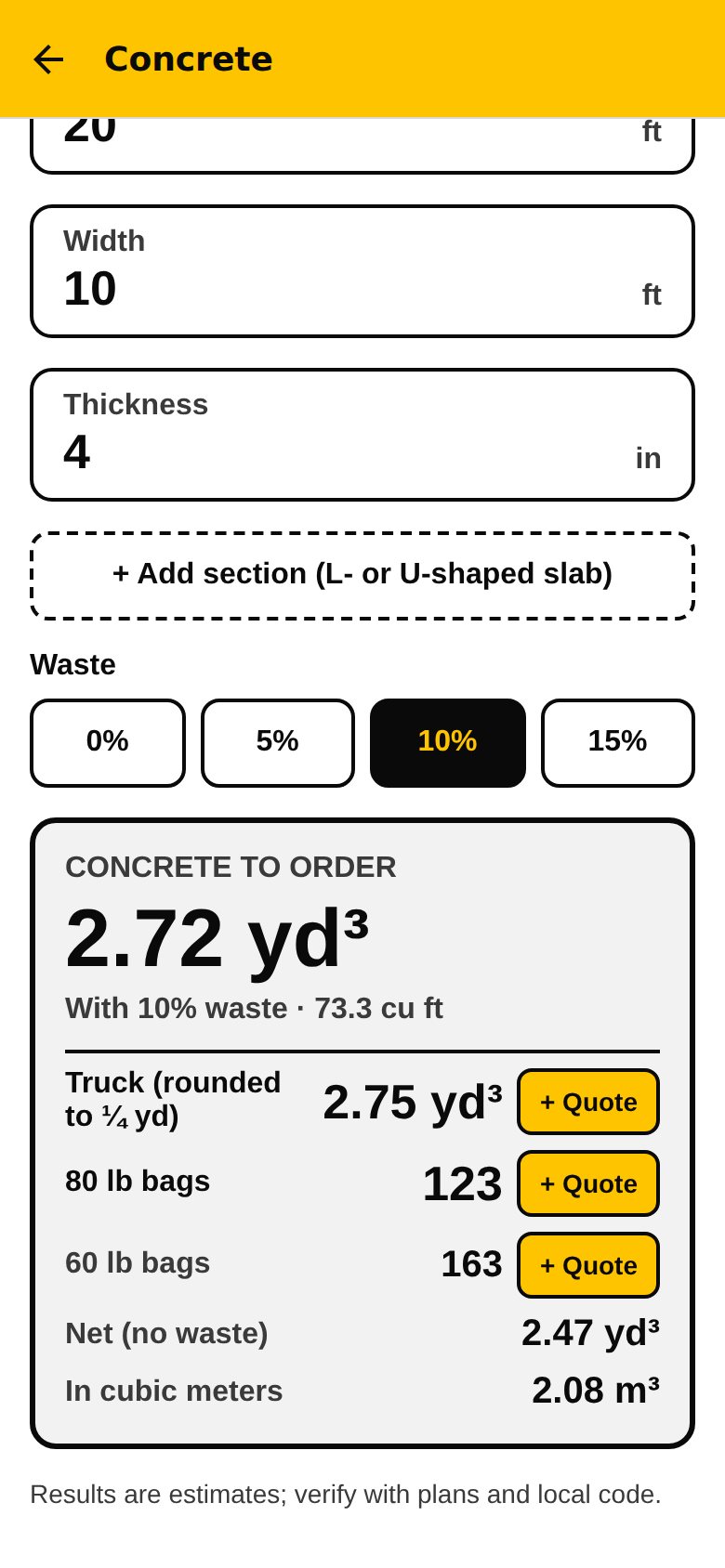
Escuadra includes concrete calculations for slabs, footings, columns and steps. All calculators in the app are free. Enter the same measurements in the app and check the waste setting before comparing the result with the 40 ft³ geometric volume here.
If an allowance is already included in the app result, do not add it a second time. You can move material quantities into a quote with “+ Quote”; PDF quotes require Escuadra Pro.
Before you order
- Confirm feet versus inches in every measurement.
- Add thickened sections separately and avoid overlapping volumes.
- Label the allowance so it is not applied twice.
- Keep quantity estimation separate from decisions about strength, reinforcement and structural thickness.
A correct volume calculation can still describe the wrong slab if the inputs do not match the plans. Review both the measurements and the arithmetic.
Questions about this estimate
Why divide by 324 instead of 27?
Use 324 when length and width are in feet but thickness is in inches. If all three measurements are already in feet, divide their product by 27.
Does 1.48 yd³ include waste?
No. It is the geometric volume of the example slab. The separate 10% demonstration increases it to about 1.63 yd³.
Sources and calculation notes
The arithmetic examples were prepared for this guide. Product-specific yields are identified where used; allowances and sample prices are stated assumptions.