 Escuadra
How Many Concrete Bags Do You Need? 60 vs 80 lb
To estimate concrete bags, divide the required mixed-concrete volume by the yield printed for the product, then round up to a whole bag. Comparing 60 lb and 80 lb bags is useful only when you know how much mixed concrete each bag produces.
Start with the yield, not just the weight
For QUIKRETE Concrete Mix No. 1101, the manufacturer lists approximate yields of 0.45 ft³ per 60 lb bag and 0.60 ft³ per 80 lb bag. The examples here use those two values. Check the current package or data sheet for the actual product you buy; a different mix can have a different yield.
These are bags of concrete mix, not bags of Portland cement alone. A cement bag does not include the same combination of ingredients, so it cannot be substituted into this bag-count calculation.
Calculate and round up once
Apply any chosen volume allowance before dividing by the yield. Keep intermediate decimals and round up only at the final bag count. For 40 ft³ without an allowance, 40 ÷ 0.60 = 66.67, so you need 67 bags of 80 lb. With 60 lb bags, 40 ÷ 0.45 = 88.89, giving 89 bags.
Compare three quantities
| Required volume | 60 lb bags | 80 lb bags |
|---|---|---|
| 27 ft³ / 1 yd³ | 60 | 45 |
| 40 ft³ | 89 | 67 |
| 44 ft³ | 98 | 74 |
The final row matches the 10 ft × 12 ft × 4 in slab example after adding an illustrative 10% to its 40 ft³ geometric volume. The first two rows have no extra allowance. The table is calculated from the published yields; it is not a guarantee that every site will require exactly that many bags.
Compare cost and handling separately
A smaller bag may be easier to handle, but the cheaper bag is not necessarily the cheaper volume. Divide the actual bag price by its yield to compare cost per cubic foot. If you are comparing a complete purchase, multiply each rounded bag count by its actual price.
For larger quantities, also ask about ready-mix delivery and compare the whole job: delivery minimums, access, equipment and handling. Those costs vary, so this guide does not invent local prices or a universal break-even quantity.
Use the concrete result in Escuadra
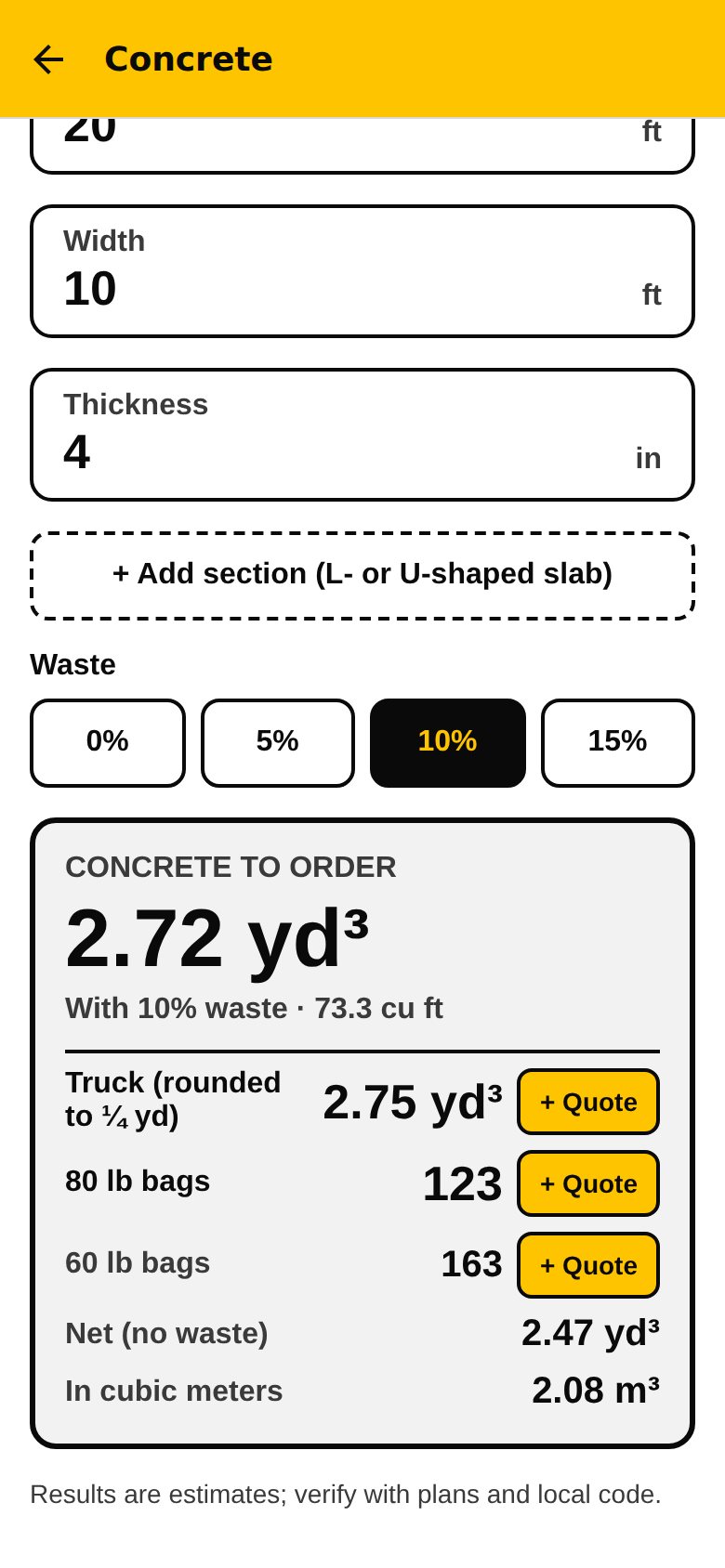
Escuadra’s free concrete module includes 60 lb and 80 lb bag estimates. Start with the same dimensions and waste assumption used in your manual calculation. If the app has already included waste, do not multiply its output by another percentage.
Before using the quantity in a quote, match the bag size to the unit price. Pricing 74 eighty-pound bags as if they were sixty-pound bags gives a misleading material total even when the volume calculation is correct.
Keep the estimate separate from mixing instructions
The bag count tells you how much product to plan for. It does not set the water quantity, mixing procedure or placement conditions. Follow the chosen product’s instructions for those steps. Save the product name and bag size with your estimate so another person can understand what the number represents.
Questions about this estimate
How many 80 lb bags make one cubic yard?
Using a yield of 0.60 ft³ per bag, 27 ÷ 0.60 = 45 bags before any added allowance.
Can I round 73.33 bags down to 73?
No. When purchasing whole bags to meet that calculated volume, round up to 74. Rounding down leaves the calculated amount short.
Sources and calculation notes
The arithmetic examples were prepared for this guide. Product-specific yields are identified where used; allowances and sample prices are stated assumptions.